Introduction
The debate of mct oil vs coconut oil has become very popular in health, fitness, and nutrition communities. Both oils come from natural sources, especially coconut, yet they behave very differently inside the body. MCT oil provides fast energy and supports ketosis, while coconut oil offers versatile uses in cooking, skincare, and traditional remedies.
Understanding mct oil vs coconut oil is important if you want to improve weight management, energy levels, brain performance, or even skin health. Many people confuse the two, but they are not the same in structure, digestion speed, or metabolic impact.
In this article, we will break down everything about mct oil vs coconut oil, including their differences, benefits, scientific insights, and real-world uses so you can clearly decide which one fits your lifestyle better.
What Are MCT Oil vs Coconut Oil?
To understand mct oil vs coconut oil, we first need to break down what each oil actually is. Although both come from coconut, manufacturers process them differently and people use them for different purposes.
This section explains their origin, structure, and how they function in the body.
What MCT Oil Is and How It Is Made
MCT oil stands for Medium-Chain Triglycerides oil, which is a concentrated form of specific fats that are easier and faster for the body to digest. When discussing MCT oil vs coconut oil, it is important to know that manufacturers extract and refine MCT oil from coconut oil or palm kernel oil because pure MCTs do not occur naturally in large amounts.
During production, manufacturers separate healthy medium-chain fats like caprylic acid (C8) and capric acid (C10) from longer-chain fats.
This makes MCT oil a more “fast-acting” energy source compared to regular coconut oil.
Because of this structure, mct oil vs coconut oil often comes down to speed of digestion and energy conversion. The body rapidly absorbs MCT oil and sends it directly to the liver for quick energy production, which makes it popular in keto diets and athletic nutrition.
What Coconut Oil Is and Its Natural Source
Coconut oil is a natural oil extracted from the meat of mature coconuts. Unlike MCT oil, it contains a mixture of different fats, including medium-chain, long-chain, and saturated fats.
When comparing mct oil vs coconut oil, coconut oil is more complex in composition. It contains lauric acid, which behaves partly like MCTs but digests more slowly in the body. This makes coconut oil more stable for cooking and better suited for heat-based applications.
People have used coconut oil for centuries in food preparation, skincare, and hair care because of its moisturizing and antimicrobial properties. However, coconut oil releases energy more slowly than MCT oil, which creates a key difference in the MCT oil vs coconut oil discussion.
How MCTs Are Extracted from Coconut Oil in MCT Oil vs Coconut Oil
The key link between mct oil vs coconut oil is extraction. Manufacturers derive MCT oil from coconut oil through a process called fractionation. During this process, they separate specific fatty acids based on their molecular structure.
Only the medium-chain fats are isolated because they are more efficient for quick energy use. These fats are then purified to create a concentrated liquid known as MCT oil.
So, while coconut oil is the natural whole-source fat, MCT oil is a refined derivative designed for targeted health benefits. This is why the comparison of often highlights coconut oil as a general-use fat and MCT oil as a functional supplement.
MCT Oil vs Coconut Oil: Key Differences You Should Know
When comparing the real difference comes from how the body processes each one and the role each plays in daily nutrition. Although both come from coconut sources, their structure and function are not the same. Understanding these differences helps you choose the right oil for your goals, such as weight loss, energy, or cooking.
Fat composition differences
The biggest difference in is their fat composition.
Manufacturers create MCT oil by isolating medium-chain triglycerides, especially caprylic acid (C8) and capric acid (C10). These fats have a shorter structure, which makes them easier to digest and convert into energy quickly.
Coconut oil, however, contains a mix of fats. It includes medium-chain fats as well as long-chain fatty acids. One major component is lauric acid, which behaves partly like an MCT but is processed more slowly by the body.
So in the comparison of MCT oil vs coconut oil, MCT oil is more concentrated, while is more balanced and closer to a whole-food fat source.
Energy production and digestion speed
Another key point in is how quickly the body digests them.
The body rapidly absorbs MCT oil and sends it straight to the liver, where it converts it into ketones that provide quick energy.
Coconut oil takes longer to digest because it contains longer-chain fats. These fats need more processing before the body can use them for energy.
This is why athletes and keto diet users often prefer MCT oil when focusing on fast energy support in oils comparisons.
Calorie use and metabolic effects
Both oils contain a similar number of calories per gram, but their effects on metabolism are different.
In MCT oil vs coconut oil, MCT oil tends to be more thermogenic, meaning the body may burn slightly more energy during digestion and ketone production.
Coconut oil provides a more steady energy release and may help with longer satiety, but it does not increase ketone production as strongly as MCT oil.
This makes MCT oil more “quick metabolism support,” while coconut oil offers more “steady energy balance.”
Processing and natural structure
Processing is another important factor in MCT oil vs coconut oil.
Manufacturers refine MCT oil to isolate specific fatty acids, making it highly concentrated and fast-acting but less natural in structure.
Coconut oil is less processed, especially extra virgin varieties, and it retains more of its natural plant compounds.
In simple terms:
MCT oil is refined and fast-absorbing
Coconut oil is natural and whole-food based
This difference plays a major role when choosing between for everyday use.
How MCT Oil vs Coconut Oil Works in the Body

Understanding how They works inside the body is key to knowing why they produce different results. Although both are fats, the body processes them through very different metabolic pathways. This difference affects energy levels, digestion, and how quickly the body uses them.
How MCT Oil vs Coconut Oil Converts into Energy
In the comparison of the biggest difference is how the body converts them into energy.
The body absorbs MCT oil directly into the portal vein and sends it straight to the liver. There, the liver rapidly breaks it down into ketones, which the body can use immediately for fuel.This process does not require long digestion, making MCT oil a fast energy source.
Coconut oil works differently. It must go through a longer digestive process involving bile and lymphatic transport. Only then are its fatty acids broken down into usable energy. This makes coconut oil slower but more sustained in its energy release.
So, when analyzing mct oil vs coconut oil, MCT oil provides quick fuel, while provides gradual energy support.
Fast Energy from MCT Oil vs Coconut Oil Slow Release Energy
Energy speed is one of the most noticeable differences in mct oil vs coconut oil.
People often call MCT oil “quick brain and body fuel” because it provides fast energy for the brain and body.
It can support immediate energy needs, especially during fasting or ketogenic diets.
Coconut oil provides a slow-burning energy source. It does not spike energy quickly but helps maintain steady fuel levels over time.
This difference is why athletes, keto followers, and people on low-carb diets often prefer MCT oil when comparing for performance and alertness.
Impact of MCT Oil vs Coconut Oil on Digestion and Absorption
Digestion is another major factor in mct oil vs coconut oil.
MCT oil is easy to digest and does not require much bile or pancreatic enzymes. This makes it suitable for people who have digestive issues or want a lighter fat source.
Coconut oil requires more digestive effort because it contains long-chain fatty acids along with medium-chain fats. However, it still supports gut health and can improve nutrient absorption when used in moderation.
In the broader view of mct oil vs coconut oil, MCT oil is more “digestive-friendly,” while coconut oil is more “nutrient-supportive.”
Health Benefits of MCT Oil vs Coconut Oil
When comparing both offer unique health benefits, but they work in different ways inside the body. People mainly value MCT oil for quick energy, weight management, and brain support, while they use coconut oil widely for heart health support, skin nourishment, and overall wellness.
Understanding the benefits of They helps you choose the right option based on your health goals, whether it is fat loss, improved focus, or better skin health.
Health Benefits Comparison Table: MCT Oil vs Coconut Oil
| Health Area | MCT Oil Benefits | Coconut Oil Benefits |
| Weight Loss | Supports fast fat burning and ketosis | Helps with satiety and reduces cravings |
| Brain Health | Provides quick ketone fuel for mental clarity | Supports long-term brain nourishment |
| Heart Health | May improve metabolism and lipid balance | Contains lauric acid that may support cholesterol balance |
| Energy | Rapid energy source, ideal for keto diets | Slow, steady energy release |
| Skin Health | Limited direct use, mostly internal benefits | Deep moisturizing and antibacterial properties |
| Hair Health | Indirect support through nutrition | Strengthens hair, reduces dryness |
| Digestion | Easy to digest, gentle on stomach | Supports gut health and nutrient absorption |
| Ketosis Support | Strong support for ketosis and fat burning | Mild support, less effective for ketosis |
Weight Loss Benefits of MCT Oil vs Coconut Oil
In MCT oil vs coconut oil, many people prefer for weight loss because the body quickly converts it into energy instead of storing it as fat.
It may also help increase calorie burning through thermogenesis.
Coconut oil supports weight management differently. It increases fullness and reduces appetite, which can help control calorie intake over time.
Brain Health Benefits of MCT Oil vs Coconut Oil
MCT oil is highly popular in brain health discussions because it produces ketones, an alternative fuel for the brain. This can support mental focus and cognitive performance.
Coconut oil also supports brain function, but in a slower and more indirect way by providing healthy fats needed for long-term brain health.
Heart Health Effects of MCT Oil vs Coconut Oil
When analysing mct oil vs coconut oil, How contains lauric acid, which may help maintain cholesterol balance when used moderately.
MCT oil may support heart health indirectly by improving metabolism and reducing fat accumulation, but research is still developing.
Skin and Hair Benefits of Coconut Oil vs MCT Oil
Coconut oil is widely used in skincare and haircare. It deeply moisturizes skin, reduces dryness, and helps protect hair from damage.
MCT oil is lighter and less commonly used directly on skin, but it can still support skin health internally through improved fat metabolism.
Read More:https://pureoilshub.com/essential-oils-for-cleaning/
MCT Oil vs Coconut Oil for Weight Loss and Ketosis
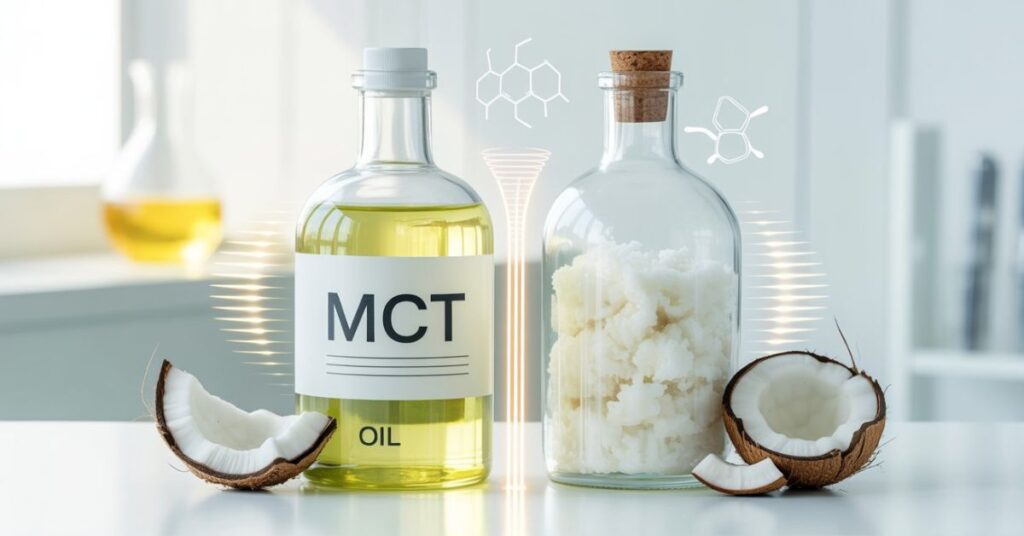
When it comes to fat loss and ketogenic diets, the comparison of They becomes especially important. Both oils can support weight management, but they work through different metabolic pathways. MCT oil acts quickly and directly, while coconut oil supports the process more slowly by improving fullness and overall fat metabolism.
Understanding how each one affects ketosis, fat burning, and appetite control can help you choose the right option for your diet goals.
Role in a ketogenic diet
In a ketogenic diet, the body uses fat instead of carbohydrates for energy. This is where shows a clear difference.
The liver rapidly converts MCT oil into ketones, making it highly effective for entering and maintaining ketosis. It requires minimal digestion, so the body gets fast and efficient energy.
Coconut oil also supports ketosis, but in a weaker way. Since it contains a mix of fatty acids, only part of it is quickly converted into ketones, while the rest is processed more slowly.
In simple terms, MCT oil supports faster ketosis, while coconut oil provides gradual support.
Fat burning and metabolism
Fat burning is another key factor in MCT oil vs coconut oil.
MCT oil may increase energy expenditure because it is rapidly metabolized. Some research suggests it can slightly boost thermogenesis, which helps the body burn more calories.
Coconut oil supports metabolism in a more gradual way. It may help improve fat oxidation over time, but it does not trigger rapid ketone production like MCT oil.
This makes MCT oil more effective for short-term metabolic support, while coconut oil contributes to long-term balance.
Appetite control and satiety
One of the most practical benefits of oils is appetite control.
MCT oil may help reduce hunger by increasing ketone levels, which signal the body that it has enough energy. This can naturally reduce calorie intake during the day.
Coconut oil also promotes fullness because of its fat content. It keeps you satisfied for longer periods, especially when added to meals or cooking.
So in MCT oil vs coconut oil, both support appetite control, but in different ways through ketosis and through sustained satiety.
Energy, Focus, and Brain Performance: MCT Oil vs Coconut Oil
When comparing one of the most important differences is how each oil affects energy levels, mental clarity, and brain performance. Both provide fuel for the body, but MCT oil acts as a rapid brain fuel, while coconut oil supports steady, long-term energy.
Below is a clear breakdown to understand their impact on focus and cognitive function.
MCT Oil as a Fast Brain Fuel vs Coconut Oil Energy Release
- The body quickly converts MCT oil into ketones, and these ketones provide an instant energy source for the brain.
- It does not require complex digestion, so energy is available within minutes
- Coconut oil releases energy slowly due to its mixed fat composition
- MCT oil is often used in ketogenic diets for immediate mental and physical energy
- Coconut oil supports overall brain health but does not create rapid ketone spikes
Mental Clarity and Focus in MCT Oil vs Coconut Oil
- MCT oil may improve mental clarity by providing fast ketone energy to brain cells
- It is commonly used during fasting or low-carb diets to reduce brain fog
- Coconut oil supports stable cognitive function through healthy fat intake
- MCT oil is preferred for short-term focus boosts, especially in demanding tasks
- Coconut oil is better for long-term nutritional brain support
Memory and Cognitive Support in MCT Oil vs Coconut Oil
- MCT oil may support memory by supplying alternative brain fuel (ketones)
- It is being studied for potential benefits in cognitive decline conditions
- Coconut oil provides essential fatty acids that support brain structure and health
- MCT oil is more performance-focused for cognition
- Coconut oil is more maintenance-focused for brain health
Uses of MCT Oil vs Coconut Oil in Daily Life
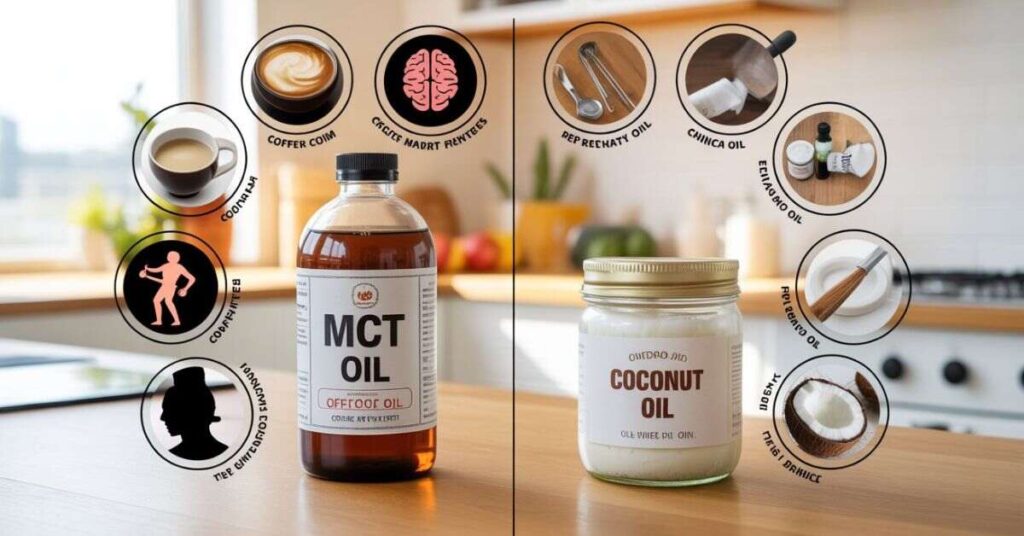
When comparing their daily uses are very different because each oil serves a unique purpose. People mainly use MCT oil as a functional supplement for energy and metabolism, while they widely use coconut oil in cooking, skincare, hair care, and general household applications.
Understanding their practical uses helps you decide which one fits better into your everyday routine.
Best Ways to Use MCT Oil in Diet and Drinks
People commonly use MCT oil as a nutritional supplement rather than a cooking oil. In the discussion of They people often add MCT oil to coffee, smoothies, protein shakes, or salad dressings to boost energy levels quickly. Since the body rapidly absorbs it, many people use it in the morning to improve focus and mental clarity throughout the day.
It is also popular in ketogenic diets because it helps increase ketone production and supports fat-burning without requiring carbohydrates. However, people do not typically use MCT oil for high-heat cooking because it has a low smoke point and works better in cold or low-temperature applications.
Cooking and Baking Uses of Coconut Oil vs MCT Oil
Coconut oil is far more versatile in cooking when comparing vs coconut oil. It can be used for frying, sautéing, baking, and even as a butter replacement in recipes. Its natural stability at higher temperatures makes it suitable for everyday cooking in many cuisines. Coconut oil also adds a mild coconut flavor that enhances both sweet and savory dishes.
In contrast, MCT oil is not ideal for cooking because it breaks down under heat and does not provide the same flavor or stability. This makes coconut oil the preferred choice for kitchen use in most households.
Beauty and Skincare Uses of Coconut Oil vs MCT Oil
People widely use coconut oil in skincare and hair care routines because of its moisturizing and antibacterial properties. They often apply it directly to the skin to reduce dryness, improve hydration, and protect against irritation.
In hair care, coconut oil helps strengthen strands, reduce protein loss, and improve shine.
When comparing people use MCT oil less often in beauty routines, although some skincare brands include it in lightweight formulations because it absorbs quickly and feels non-greasy.
Still, coconut oil remains the dominant choice for natural beauty treatments.
Functional Nutrition Uses of MCT Oil vs Coconut Oil
From a functional nutrition perspective, mct oil vs coconut oil shows a clear difference in purpose.People primarily use MCT oil to support energy metabolism, ketosis, and cognitive performance, so athletes, keto followers, and people practicing intermittent fasting often prefer it. People use coconut oil as a general dietary fat that provides steady energy, supports satiety, and contributes to overall wellness.
While MCT oil works more like a performance booster, coconut oil works as a traditional, all-purpose dietary fat that people easily integrate into everyday meals.
Side Effects and Safety of MCT Oil vs Coconut Oil
When comparing vs coconut oil, it is important to understand that both are generally safe for most people, but they can cause side effects if used incorrectly or in excess. Since both oils are high in fat, the body may react differently depending on individual tolerance, dosage, and overall diet. Knowing their safety profile helps you use them in a balanced and healthy way.
Possible Side Effects of MCT Oil vs Coconut Oil
In the comparison of vs coconut oil, MCT oil is more likely to cause digestive discomfort, especially when taken in large amounts. Some people may experience nausea, bloating, or loose stools because the digestive system rapidly absorbs MCT oil and can become overwhelmed if they introduce it too quickly.
Coconut oil, on the other hand, is usually easier to tolerate but may still cause mild digestive issues in sensitive individuals if consumed in excess. Since it contains a mix of fats, the body processes it more slowly, which generally reduces the risk of sudden discomfort. However, overconsumption of coconut oil may contribute to unwanted calorie intake.
Digestive Issues and Sensitivity Risks
When analysing vs coconut oil, digestive sensitivity plays a key role. MCT oil is highly concentrated and acts quickly in the gut, so it can cause digestive upset if the body is not used to it.
That is why experts recommend starting with small doses and gradually increasing intake.
Coconut oil is usually gentler on digestion because it is closer to a whole-food fat. It supports gut health in moderate amounts and is less likely to cause immediate digestive reactions. However, people with fat sensitivity may still need to monitor their intake of both oils carefully.
Who Should Avoid MCT Oil vs Coconut Oil
In the discussion of vs coconut oil, certain individuals should be cautious. People with liver conditions should consult a healthcare professional before using MCT oil, as it is processed directly in the liver. Those with sensitive stomachs may also need to limit intake to avoid discomfort.
Coconut oil should be used carefully by individuals who need to monitor saturated fat intake, especially those with specific cardiovascular concerns. While it is natural, excessive use may still contribute to high calorie intake, which is important to consider in weight management plans.
Safe Daily Usage Guidelines
When comparing vs coconut oil, moderation is key for both. People typically start MCT oil in small doses, such as one teaspoon per day, and they gradually increase it to avoid digestive issues. It works best in drinks or cold foods rather than cooking.
Coconut oil, on the other hand, people can use more freely in cooking, baking, or skincare routines, but they should still consume it in balanced amounts as part of a healthy diet.
Most people can safely include it daily without issues if intake is moderate and aligned with overall calorie needs.
Scientific Evidence Behind MCT Oil vs Coconut Oil

When comparing coconut oil, scientific research plays an important role in understanding how each oil actually works in the body. While both oils are widely used in health and nutrition, studies show that their effects differ in metabolism, heart health, and ketone production. Below is a clear breakdown based on scientific findings.
Scientific Evidence Comparison Table: MCT Oil vs Coconut Oil
| Research Area | MCT Oil Findings | Coconut Oil Findings |
| Ketone Production | Strong evidence shows MCT oil rapidly increases ketone levels in the blood | Mild ketone increase due to partial MCT content |
| Weight Loss Studies | Some studies show modest fat loss and increased energy expenditure | Limited evidence for direct weight loss benefits |
| Brain Health Research | Supports ketone-based brain fuel, studied in cognitive decline support | Provides long-term fat support for brain structure |
| Heart Health Studies | Mixed results; may improve metabolism but needs more research | Contains lauric acid which may raise HDL cholesterol |
| Cholesterol Impact | Neutral to mild effect depending on intake | May increase both LDL and HDL cholesterol |
| Energy Metabolism | Rapid conversion into energy in the liver | Slower digestion and gradual energy release |
| Scientific Consensus | Strong for ketosis and quick energy support | Strong for traditional dietary fat use but less specific metabolic impact |
Research on MCT Oil vs Coconut Oil and Ketones
Scientific studies clearly show that MCT oil significantly increases ketone production compared to coconut oil. This is because MCTs are quickly absorbed and transported directly to the liver, where they are converted into ketones. In contrast, coconut oil only provides a partial amount of MCTs, so its effect on ketone levels is weaker and slower.
Scientific Findings on Heart Health and Cholesterol
Research on shows mixed results for heart health. MCT oil appears to have a neutral to mildly positive effect on metabolism but lacks long-term cardiovascular studies.
Research shows that coconut oil can increase both HDL (good cholesterol) and LDL (bad cholesterol), so its overall impact on heart health becomes more complex and depends on individual health conditions.
Marketing Claims vs Real Evidence
In the comparison of vs coconut oil, it is important to separate marketing claims from scientific facts. People often promote MCT oil for rapid fat loss and brain boosting, and some evidence supports these claims, but results usually stay modest.
People market coconut oil as a superfood, but scientific evidence mainly supports its use as a stable cooking fat rather than a direct weight-loss solution.
Which Is Better: MCT Oil vs Coconut Oil?
When comparing mct oil vs coconut oil, there is no single “perfect” winner for everyone. The better choice depends on your personal goals such as weight loss, cooking needs, energy levels, and overall lifestyle. Each oil has its own strengths, and understanding them helps you make a smarter health decision.
Best Choice for Weight Loss Goals
For weight loss, mct oil vs clearly leans in favor of MCT oil. The body rapidly converts it into energy instead of storing it as fat, and it may support ketosis, which helps the body burn fat more efficiently.
Coconut oil also supports weight management by increasing fullness and reducing cravings, but its effect is slower and less direct compared to MCT oil.
Best Choice for Cooking and Daily Use
In everyday cooking, therefore strongly favors coconut oil. People can heat coconut oil safely, and it stays stable during frying, baking, and sautéing without breaking down easily. However, people do not use MCT oil for high-heat cooking, and they mainly add it to drinks, smoothies, or cold dishes.
This makes coconut oil the more practical kitchen option.
Best Choice for Energy and Brain Performance
When it comes to energy and mental performance, mct oil vs shows MCT oil as the better option. It provides quick ketone-based fuel that can improve focus, alertness, and mental clarity. Coconut oil provides steady, long-term energy but does not deliver the same fast cognitive boost as MCT oil. This makes MCT oil more suitable for fasting, keto diets, and productivity support.
Economic and Practical Factors of MCT Oil vs Coconut Oil
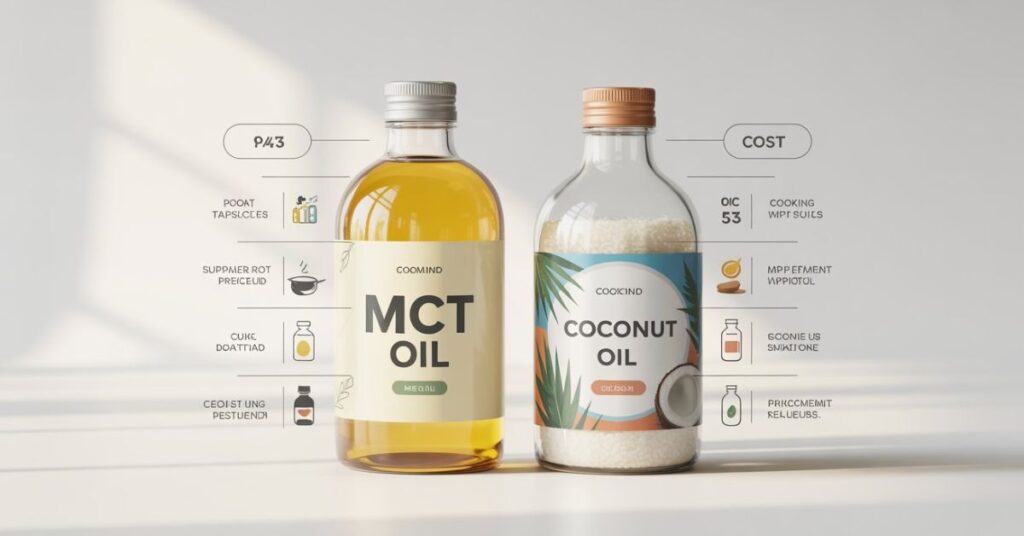
When analyzing mct oil vs coconut oil, cost, availability, and practicality play an important role in deciding which one is better for daily use. While both oils come from coconut sources, their production process and refinement level make them very different in price and accessibility.
Cost Comparison of MCT Oil vs Coconut Oil
In terms of price, mct oil vs shows a clear difference. MCT oil is significantly more expensive because it goes through a refined extraction process that isolates specific medium-chain fats. This purification increases production costs, which is reflected in its market price.
Coconut oil is much more affordable and widely available. Since manufacturers extract it directly from coconut meat with minimal processing, it remains a budget-friendly option for most households.
For long-term daily use, coconut oil is generally the more economical choice in the oils comparison.
Environmental Impact and Sustainability
From a sustainability perspective, mct oil vs also has differences. Coconut oil production is generally considered more natural and less resource-intensive, especially when sourced from sustainable farms. It uses the whole coconut and requires fewer industrial processing steps.
MCT oil, however, involves additional refining and fractionation processes, which increases industrial energy use. However, it is still derived from coconut or palm kernel oil, meaning its environmental impact depends heavily on sourcing practices. Ethical sourcing can improve its sustainability profile in the oils comparison.
Storage and Availability Differences
When comparing mct oil vs coconut oil, storage and availability are also important factors. Coconut oil is widely available in supermarkets, grocery stores, and online markets. It can also solidify at cooler temperatures, but this does not affect its quality.
MCT oil is also available globally but is more commonly found in health stores or supplement sections. It stays in liquid form at all temperatures, making it easier to mix into drinks and smoothies. However, it is not as commonly stocked in everyday kitchens as coconut oil, which limits its practical use in some regions.
Final Verdict on MCT Oil vs Coconut Oil
When it comes to mct oil vs coconut oil, the final verdict is that neither oil is universally “better” instead, each one serves a different purpose depending on your health goals and lifestyle needs.
MCT oil is best suited for people who want fast energy, improved mental focus, and strong support for ketosis and fat burning. It works quickly in the body and is especially useful for ketogenic diets, intermittent fasting, and performance-focused nutrition.
Coconut oil, on the other hand, is more versatile and traditional. It is excellent for cooking, baking, skincare, and general daily use. It provides steady energy, supports fullness, and offers natural benefits that fit easily into everyday life.
So in the comparison of coconut oil, the smarter approach is not choosing one over the other, but using them based on your specific needs. If you want fast metabolic support and brain fuel, MCT oil is ideal. If you want a stable, multi-purpose natural oil, coconut oil is the better option.
Ultimately, both oils can complement each other in a balanced diet. Understanding their differences helps you make informed choices that support better health, energy, and overall wellness.
FAQs:
Can you use MCT oil and coconut oil together?
Yes, you can use mct oil vs coconut oil together in your diet. Many people combine both to get the benefits of fast energy from MCT oil and the stable nutrition from coconut oil. For example, MCT oil can be added to coffee or smoothies, while coconut oil can be used in cooking meals.
Is MCT oil better than coconut oil for ketosis?
Yes, in most cases favors MCT oil for ketosis. MCT oil is rapidly converted into ketones, which helps the body enter and maintain ketosis faster. Coconut oil also supports ketosis but in a slower and less direct way.
Which oil is better for cooking?
In mct oil vs coconut oil, coconut oil is better for cooking. It is heat-stable and can be used for frying, baking, and sautéing. MCT oil is not suitable for high heat and is mainly used in drinks or cold recipes.
Are there any side effects?
Yes, both oils may cause side effects if overused. In coconut oil, MCT oil may cause digestive issues like bloating or diarrhea if taken in large amounts. Coconut oil is generally well tolerated but may contribute to excess calorie intake if not used in moderation.
Which is better for weight loss?
For weight loss, mct oil vs coconut oil generally favors MCT oil. It supports faster fat burning and energy production. Coconut oil helps with satiety and appetite control, but MCT oil is more effective for quick metabolic support.