

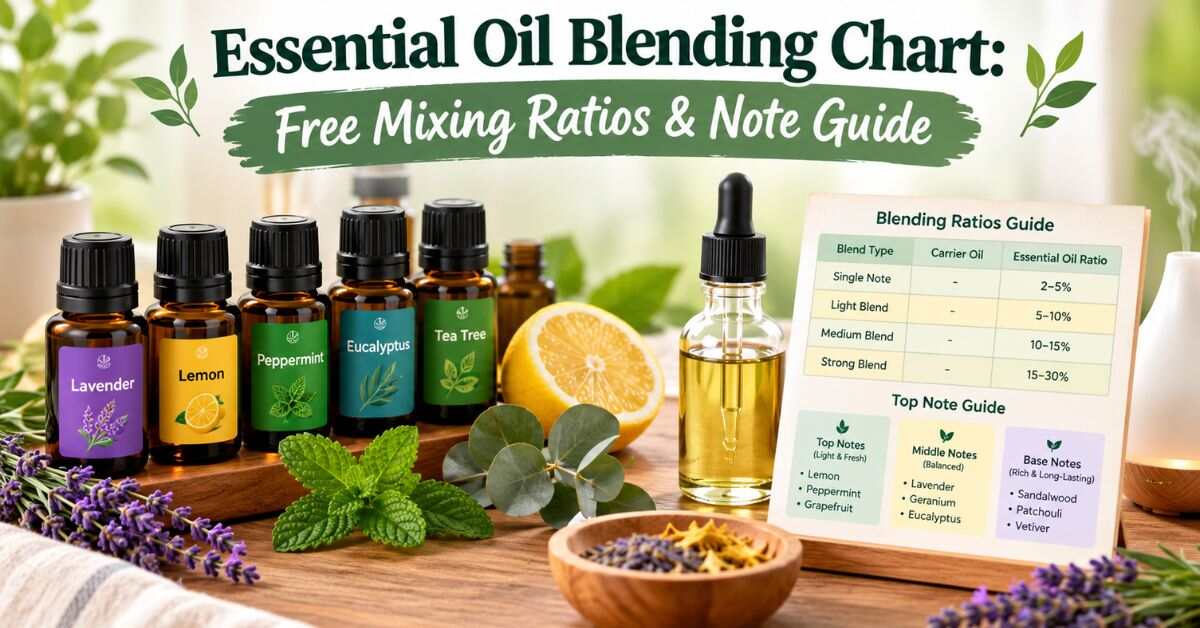
Introduction to Essential Oil Blending Charts & Aromatic Fundamentals
Unlocking the art of aromatherapy requires an intuitive understanding of aromatic balance, chemistry, and volatility. Whether you want to formulate custom body oils, create captivating home fragrances, or make therapeutic skincare products, an essential oil blending chart serves as your ultimate master blueprint.
Creating custom scents is both a creative art and a precise science. Without a structured framework, combining powerful plant extracts can result in muddy, overpowering, or off-putting aromas. This section breaks down the foundational principles of aromatic notes, scent categories, and human olfactory perception so you can mix your oils with total confidence.
What Is an Essential Oil Blending Chart and Why Do You Need One?
An essential oil blending chart is a professional visual reference that categorizes natural plant extracts by their volatility, scent profile, and botanical harmony. An intuitive essential oil blending chart guides formulators on which plant extracts mix smoothly without aromatic conflict. Furthermore, checking structured reference tables reveals how long individual volatile notes linger in ambient air or on dermal tissue. Consequently, calculating exact drop measurements ensures optimal harmony across top, middle, and base notes without overwhelming delicate senses. In addition, following precise ratio recommendations protects user safety while preserving overall formulation balance.
On the other hand, mixing active drops without clear guidance often leads to harsh scent clashes or wasted raw materials. Therefore, relying on systematic data from an essential oil blending chart simplifies custom recipe creation for formulators of all experience levels. Ultimately, mastering precise drop calculations guarantees consistent, high-value botanical products with superior aromatic appeal.
Without a reliable reference chart, formulating custom plant oil mixtures often leads to wasted ingredients and harsh, unbalanced aromas. Here is why every beginner and experienced formulation enthusiast needs a dedicated guide:
- Prevents Scent Muting: Helps you avoid mixing strong, heavy oils that completely overwhelm delicate, soft botanical notes.
- Saves Precious Ingredients: Concentrated pure plant extracts are expensive; structured drop ratios prevent wasteful trial-and-error mistakes.
- Ensures Therapeutic Synergy: Pairing complementary botanical oils enhances their combined wellness benefits, creating a stronger overall effect.
- Guarantees Reproducible Batches: Documented proportions allow you to recreate your favorite signature blends consistently every single time.
How Essential Oils Support Everyday Care, Health, and Emotional Wellness
Pure plant extracts interact directly with your body through topical absorption and aromatic inhalation. When diffusing an aromatic mixture or applying a correctly diluted skin treatment, natural volatile molecules stimulate physiological pathways through two distinct mechanisms. Furthermore, checking a detailed essential oil blending chart helps select optimal active compounds that target either olfactory receptors or dermal layers effectively. Consequently, airborne molecules interact with the limbic system via nasal passages to evoke swift emotional and psychological responses.
In addition, topical absorption allows beneficial lipid-soluble active compounds to enter skin tissue gently, supporting localized tissue wellness. On the other hand, applying improper concentrations without structured guidance can provoke unexpected skin sensitivities or olfactory fatigue. Therefore, relying on precise ratios from an essential oil blending chart optimizes therapeutic efficiency while ensuring maximum application safety. Ultimately, understanding dual stimulation pathways enables formulators to design highly effective, safe botanical wellness routines.
1. Aromatic Inhalation & Neurological Response
Inhaling micro-droplets of plant essence stimulates sensory receptors inside the nasal cavity. These nerve pathways send instant signals to the limbic region of the brain, which manages emotions, stress responses, memory retrieval, and heart rate regulation.
2. Transdermal Absorption & Skincare
When combined with nutrient-rich plant lipid vehicles like jojoba, argan, or sweet almond, concentrated active drops absorb deeply into outer epidermal layers. Furthermore, referencing a reliable essential oil blending chart provides appropriate dilution measurements to maximize tissue absorption while preventing localized sensitivity. Consequently, mixing potent extracts into nourishing base lipids protects skin barrier integrity effectively. In addition, these lipid carriers nourish surface tissue while facilitating the steady release of aromatic compounds. On the other hand, applying undiluted concentrated drops directly to delicate skin often leads to sudden redness or cutaneous irritation.
Therefore, utilizing exact proportional guidance from an essential oil blending chart ensures optimal dermal safety and therapeutic benefits. Ultimately, selecting nutrient-rich plant lipid vehicles transforms volatile remedies into deeply restorative, skin-nourishing formulations. They deliver protective antioxidants, soothing essential fatty acids, and natural purifying compounds straight to skin cells.
Pro Tip: For immediate stress relief, combine 2 drops of French Lavender with 1 drop of Sweet Orange on a tissue and inhale deeply three times.
The Olfactory System: Understanding Fragrance Perception and Scent Volatility
Human olfactory receptors detect thousands of subtle volatile aromatic compounds. However, volatile plant extracts display varying evaporation rates depending on their molecular weights and chemical structures. Furthermore, consulting a detailed essential oil blending chart categorizes these aromatic compounds into distinct evaporation speed tiers like top, middle, and base notes. Consequently, fast-evaporating citrus elements disperse rapidly into the air, whereas dense resinous extracts dissipate much more slowly over several hours. In addition, understanding these differing volatility rates allows formulators to construct well-balanced scents that evolve continuously throughout the day.
On the other hand, combining extracts with similar dissipation speeds without proper planning often produces flat, short-lived aromatic profiles. Therefore, utilizing systematic guidance from an essential oil blending chart ensures long-lasting scent stability across all custom formulations. Ultimately, mastering molecular evaporation dynamics guarantees professional-quality, high-value botanical products with every batch. Volatility refers to how quickly an oil turns into vapor and dissipates into the surrounding air.
| Volatility Level | Evaporation Speed | Initial Perception | Common Botanical Examples |
| High Volatility | Fast (15–30 minutes) | Immediate, sharp, bright | Lemon, Bergamot, Grapefruit, Peppermint |
| Medium Volatility | Moderate (2–4 hours) | Smooth, rounded, full-bodied | Lavender, Rosemary, Geranium, Chamomile |
| Low Volatility | Slow (6–24+ hours) | Rich, deep, grounding | Frankincense, Vetiver, Cedarwood, Patchouli |
Understanding evaporation rates ensures your homemade formulas deliver an inviting initial impression, a rich core body, and a comforting, long-lasting scent trail.
Essential Oil Note Categories: Defining Top, Heart (Middle), and Base Notes
Every successful aromatic formula relies on a classic three-tier note structure. Balancing these three layers prevents your fragrance from vanishing too quickly or feeling unpleasantly heavy.
- Top Notes (20% – 30% Blend Ratio): Light, energetic, first scent impression that evaporates quickly (10 to 30 minutes).
- Heart / Middle Notes (40% – 50% Blend Ratio): The main theme, personality, and body scent lasting 2 to 4 hours.
- Base Notes (10% – 20% Blend Ratio): Deep, rich anchor that lingers on skin or in the air for 6 to 24+ hours.
Top Notes (The First Impression)
Top notes deliver the immediate burst of fragrance upon unsealing a container or initiating a diffuser. Furthermore, consulting a clear essential oil blending chart highlights these highly volatile molecules, such as lemon or grapefruit, which elevate energy levels instantly. Consequently, these light, vibrant aromas vaporize quickly, naturally subsiding within thirty minutes of exposure. In addition, pairing these fleeting head notes with heartier elements creates a seamless transition into deeper aromatic layers.
On the other hand, omitting these initial scent layers leaves custom mixtures feeling flat or overly dense. Therefore, applying standard ratios from an essential oil blending chart preserves initial brightness without compromising overall blend longevity. Ultimately, understanding volatile head note dynamics ensures captivating, well-balanced formulations right from the first sniff.
Heart or Middle Notes (The Core Character)
Heart notes form the true core personality of your mix. As the sharp top notes fade, heart notes emerge to harmonize the entire formula, lasting up to four hours on skin or in ambient air.
Base Notes (The Anchoring Foundation)
Base notes consist of heavy, complex molecules that evaporate slowly over many hours. They anchor lighter notes, ground the entire aromatic profile, and ensure your custom blend retains its depth over time.
Aromatic Families Explained: Floral, Citrus, Woody, Herbal, Spicy, and Earthy
To craft professional-grade formulas, you must group your raw plant extracts into their respective aromatic families. Plant extracts classified within identical or adjacent olfactory families integrate seamlessly to create smooth, balanced compositions. Furthermore, referencing a comprehensive essential oil blending chart helps formulators identify natural botanical affinities between uplifting citrus notes and calming floral extracts. Consequently, pairing closely related scent categories minimizes harsh aromatic clashes while enhancing overall depth. In addition, combining neighboring family profiles allows subtle undertones to unify without overwhelming sensitive olfactory senses.
On the other hand, mixing completely incompatible fragrance groups without structured guidance often produces unappealing, discordant results. Therefore, utilizing systematic insights from an essential oil blending chart streamlines recipe development and eliminates guesswork. Ultimately, mastering olfactory family relationships ensures high-quality, professional-grade results for every custom batch.
Floral Family
- Key Profiles: Sweet, soft, elegant, romantic, and calming.
- Popular Oils: Lavender, Ylang Ylang, Jasmine, Geranium, Neroli.
- Best Used For: Nighttime relaxation formulas, soothing facial serums, and stress-relief misting sprays.
Citrus Family
- Key Profiles: Zesty, crisp, sunny, uplifting, and clean.
- Popular Oils: Sweet Orange, Bergamot, Pink Grapefruit, Key Lime, Tangerine.
- Best Used For: Morning diffuser blends, household surface cleaners, and mood-boosting room mists.
Woody Family
- Key Profiles: Warm, resinous, forest-like, grounding, and steady.
- Popular Oils: Cedarwood, Sandalwood, Cypress, Juniper Berry, Black Spruce.
- Best Used For: Men’s grooming oils, grounding meditation mixtures, and evening beard balms.
Herbal Family
- Key Profiles: Fresh, green, medicinal, crisp, and clarifying.
- Popular Oils: Rosemary, Peppermint, Spearmint, Tea Tree, Eucalyptus, Clary Sage.
- Best Used For: Focus-boosting study blends, clear-breathing steam chest rubs, and scalp-clarifying hair treatments.
Spicy Family
- Key Profiles: Exotic, warm, pungent, stimulating, and rich.
- Popular Oils: Cinnamon Bark, Clove Bud, Ginger, Cardamom, Black Pepper.
- Best Used For: Autumn diffuser blends, warming body massage oils, and cozy room sprays.
Earthy & Resinous Family
- Key Profiles: Deep, musky, balsamic, meditative, and rooted.
- Popular Oils: Patchouli, Vetiver, Frankincense, Myrrh.
- Best Used For: Long-lasting cologne anchors, deep sleep formulas, and mature skin recovery creams.
Using a comprehensive essential oil blending chart as your guide makes balancing these complex aromatic notes straightforward, fun, and safe.
Master Essential Oil Blending Chart: Compatibility & Pairing Matrix
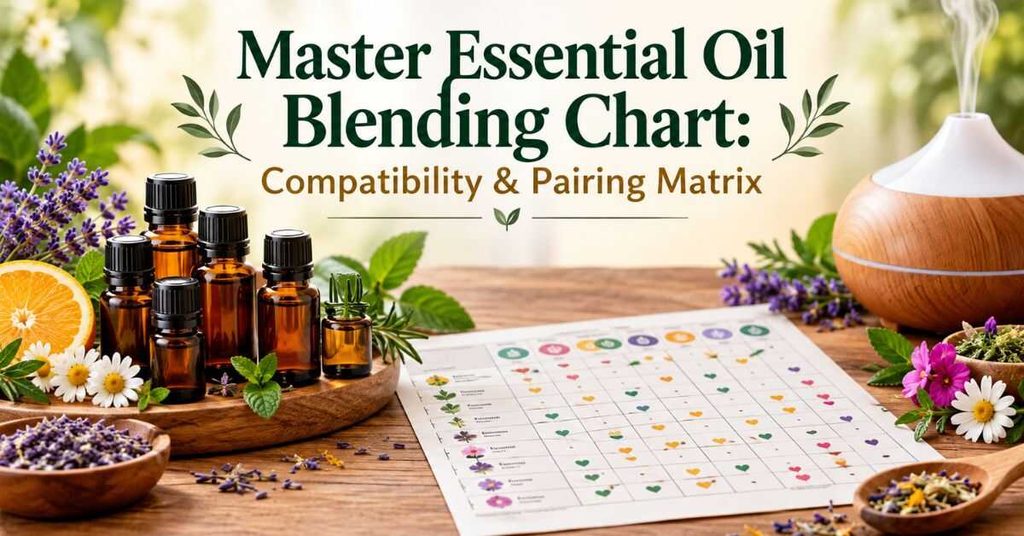
Navigating fragrance synergy becomes effortless when you have a structured pairing matrix. Combining essential oils requires an understanding of how distinct botanical families interact. By consulting an intuitive essential oil blending chart, formulators can rapidly identify complementary aromatic profiles while avoiding harsh scent disharmony. Furthermore, relying on structured reference guides simplifies selecting harmonious pairings like invigorating citrus extracts and grounding herbal notes. Consequently, evaluating scent notes beforehand protects valuable liquid ingredients from wasteful experimentation. In addition, understanding natural botanical affinities ensures that top, middle, and base elements blend seamlessly into balanced compositions. On the other hand, mixing volatile compounds without checking drop compatibility often produces muddy, unappealing aromas.
Therefore, utilizing systematic guidance from an essential oil blending chart streamines every step of custom product creation. Ultimately, applying mindful aroma selection principles guarantees consistent, high-quality results for personal or professional formulations.
Quick-Reference Essential Oil Blending Chart for Beginners
This primary reference matrix highlights how popular essential oils classify by scent note, aromatic family, and natural blending partners.
| Essential Oil | Note Level | Aromatic Family | Ideal Blending Partners | Primary Benefit |
| Lavender | Heart / Middle | Floral | Bergamot, Cedarwood, Frankincense, Clary Sage | Deep Relaxation & Sleep |
| Peppermint | Top | Herbal / Minty | Lemon, Rosemary, Eucalyptus, Tea Tree | Mental Alertness & Cooling |
| Sweet Orange | Top | Citrus | Cinnamon, Clove, Frankincense, Lavender | Mood Elevation & Energy |
| Frankincense | Base | Earthy / Resinous | Bergamot, Lavender, Sandalwood, Myrrh | Grounding & Skin Renewal |
| Tea Tree | Top / Middle | Herbal | Lavender, Lemon, Rosemary, Eucalyptus | Clarifying & Purifying |
| Eucalyptus | Top | Herbal / Camphoraceous | Peppermint, Cedarwood, Lemon, Spearmint | Clear Breathing & Refreshment |
| Cedarwood | Base | Woody | Bergamot, Clary Sage, Lavender, Rosemary | Emotional Balance & Calm |
| Bergamot | Top | Citrus | Jasmine, Lavender, Patchouli, Ylang Ylang | Stress Relief & Uplifting |
| Ylang Ylang | Heart / Base | Floral | Bergamot, Grapefruit, Vetiver, Sandalwood | Sensual Comfort & Harmony |
| Rosemary | Middle | Herbal | Peppermint, Lemon, Cedarwood, Frankincense | Focus & Scalp Vitality |
Harmonious Blending: Which Aromatic Categories Pair Best Together?
Not every botanical family needs to mix with every other to create a pleasing aroma. Certain scent groups share chemical constituents or contrasting notes that naturally blend together:
- Citrus Pairs Exceptionally Well With: Floral, Woody, Spicy, and Herbal families. Citrus acts as a bright top bridge that softens sharp woods and heavy spices.
- Florals Pair Exceptionally Well With: Citrus, Spicy, and Woody families. Floral notes add elegance and round out harsh or resinous base notes.
- Woody Oils Pair Exceptionally Well With: Citrus, Floral, Herbal, Earthy, and Spicy families. Woods serve as versatile structural anchors for almost any blend.
- Herbal Oils Pair Exceptionally Well With: Citrus, Minty, and Woody families. Green herbs add crisp, medicinal vitality to light citrus notes.
- Spicy Oils Pair Exceptionally Well With: Citrus, Floral, and Earthy families. Incorporating warm spice extracts like cinnamon, clove, or nutmeg delivers comforting aromatic depth when measured in minimal drop ratios. Furthermore, referencing a detailed essential oil blending chart ensures these potent spicy notes harmonize with softer floral or citrus layers without overpowering the composition. Consequently, utilizing low concentrations guards delicate skin barriers against hot, irritating sensations.
- In addition, pairing rich spice notes with sweet orange or frankincense creates an inviting, cozy atmosphere during cooler seasons. On the other hand, pouring heavy spice drops without precise measurement can easily cause sensory overload or skin sensitivity. Therefore, following safety thresholds specified on an essential oil blending chart preserves balance while keeping dermal applications safe. Ultimately, applying mindful spice ratios transforms intense extracts into soothing, high-quality aromatic mixtures.
Popular Essential Oil Pairings for Daily Aromatherapy
If you are looking for quick, tried-and-tested combinations using a standard essential oil blending chart, these two-oil pairings are widely loved for their foolproof scent profiles:
- Lavender + Sweet Orange: The ultimate beginner pairing, balancing calming floral notes with cheerful citrus brightness.
- Peppermint + Rosemary: A classic morning energy catalyst that stimulates mental sharpness and focus.
- Frankincense + Bergamot: A sophisticated, grounding mix perfect for evening meditation and reducing stress.
- Eucalyptus + Tea Tree: A crisp, purifying combination that clears ambient air and supports clear airways.
- Cedarwood + Ylang Ylang: A rich, exotic balance of woody strength and soft floral sweetness.
Pro Tip: When trying out a new pairing for the first time, hold open bottles of the two oils together right under your nose and gently wave your hand to waft the combined air. This quick smell test gives you a preview before you drop a single drop into a diffuser!
Essential Oil Incompatibilities: Oils That Do Not Blend Well Together
While most plant extracts blend harmoniously, certain combinations clash due to conflicting volatile compounds. Mixing contrasting heavy notes often creates a muddy, unappealing fragrance.
Here are a few combinations to avoid or handle with extra care:
- Heavy Spice + Delicate Floral (e.g., Clove + Jasmine): Strong spice notes easily overpower soft florals like Jasmine or Neroli, completely ruining their delicate fragrance profile.
- Sharp Mint + Deep Earthy (e.g., Peppermint + Patchouli): The intense cooling sharpness of Peppermint clashes aggressively with the heavy, damp soil notes of Patchouli.
- Camphoraceous + Sweet Citrus (e.g., Tea Tree + Sweet Orange): Medicinal, pungent Tea Tree can make bright Sweet Orange smell medicinal and sour if the drop ratio is imbalanced.
How to Fix an Imbalanced Scent Profile in Your Blend
Even experienced formulators occasionally mix a formulation that feels overly sharp, excessively heavy, or unpleasantly medicinal. Furthermore, reviewing a reliable essential oil blending chart offers immediate troubleshooting solutions to restore proper scent equilibrium before discarding the batch. Consequently, adding a few drops of bright citrus extracts softens harsh herbal notes while lifting heavy resinous base profiles. In addition, incorporating soothing floral compounds like lavender or chamomile rounds out sharp, medicinal undertones seamlessly.
On the other hand, attempting random corrections without referencing structured dilution guides can further unbalance fragile fragrance profiles. Therefore, utilizing calculated corrective adjustments from an essential oil blending chart rescues flawed mixtures and preserves precious plant ingredients. Ultimately, applying mindful formulation troubleshooting turns challenging blending mistakes into refined, professional-quality aromatic products.
1. If the Blend Is Overpoweringly Heavy or Earthy
- The Fix: Add 2 to 3 drops of a bright, high-volatility citrus oil like Lemon or Pink Grapefruit. Citrus top notes cut through heavy base notes and lift the overall fragrance profile immediately.
2. If the Blend Is Too Sharp, Medicinal, or Harsh
- The Fix: Add 1 to 2 drops of a smoothing, rounded heart note like French Lavender or Geranium. Middle-note florals bridge the gap between sharp top notes and deep base notes.
3. If the Blend Vanishes Too Quickly
- The Fix: Add 1 drop of a slow-evaporating base note like Frankincense, Cedarwood, or Sandalwood. Base notes anchor volatile top notes so your scent lasts longer in the air.
Read More: fish oil benefits for hair || tea tree oil for hair growth || oil slick hair || essential oils for vertigo
The Science of Ratios: How to Master the Essential Oil Blending Rule
Mastering aromatherapy is all about understanding scent ratios and evaporation dynamics. Constructing a master formula requires applying precise percentage ratios to prevent a single dominant note from overwhelming the entire scent profile. Furthermore, consulting a reliable essential oil blending chart establishes perfect equilibrium among top, middle, and base notes. Consequently, balancing volatile floral, citrus, and herbal compounds creates a well-rounded aromatic experience that unfolds smoothly over time. In addition, using exact drop calculations protects delicate top notes from being completely buried by heavy resinous extracts.
On the other hand, mixing plant extracts without structured proportional guidelines often leads to muddy, unbalanced aromas that dissipate unpredictably. Therefore, relying on standardized ratios provided by an essential oil blending chart ensures consistent, professional-grade formulations with every batch. Ultimately, mastering structured ratio principles allows formulators to craft harmonious, high-value botanical products with absolute confidence.
Understanding the 30-50-20 Rule on an Essential Oil Blending Chart
The standard 30-50-20 formula is a recognized golden ratio used by professional perfumers. This structural framework divides total volume into three distinct tiers:
- 30% Top Notes: Fast-evaporating oils delivering the initial scent impression.
- 50% Heart / Middle Notes: Medium-evaporating extracts forming the central character.
- 20% Base Notes: Slow-evaporating oils anchoring the mixture for extended longevity.
Standard 10-Drop Blend Breakdown for an Essential Oil Blending Chart
To visualize this rule in practice, consider a standard 10-drop diffuser mixture:
- 3 Drops Top Note: Bergamot or Lemon
- 5 Drops Middle Note: Lavender or Roman Chamomile
- 2 Drops Base Note: Cedarwood or Frankincense
Chemical Volatility Principles for an Essential Oil Blending Chart
The scientific foundation behind classical ratios rests on molecular weight and volatility rates. Plant extracts contain diverse chemical constituents that evaporate at varying speeds:
- Monoterpenes (Top Notes): Small molecules like limonene and pinene dissipate rapidly into the air, providing immediate sensory engagement.
- Alcohols and Esters (Middle Notes): Medium-weight compounds such as linalool and linalyl acetate evaporate steadily over several hours, sustaining the central identity.
- Sesquiterpenes and Resins (Base Notes): Heavy, complex structures like patchoulol and alpha-santalol evaporate very slowly, binding lighter molecules to prolong fragrance duration.
Structuring your formula across these three levels ensures a smooth transition rather than an abrupt sensory decline.
Aroma Strength and Blending Factors on an Essential Oil Blending Chart
Essential oils vary significantly in scent strength. Highly concentrated extracts can dominate a standard mixture if added in equal amounts. Professional formulators assign every oil a Blending Factor (BF) from 1 to 10 to guide adjustments:
| Oil Category | Blending Factor (BF) | Aroma Intensity | Application Rule |
| Vetiver, Patchouli, Jasmine, Ylang Ylang | 1 – 2 | Extremely High / Dominant | Use sparingly (1 drop or toothpick dip) |
| Cinnamon, Peppermint, Clove, Rose | 3 – 5 | High / Strong | Limit to 1–2 drops maximum |
| Lavender, Rosemary, Geranium, Tea Tree | 6 – 7 | Moderate | Follow standard 30-50-20 percentages |
| Lemon, Sweet Orange, Grapefruit, Bergamot | 8 – 10 | Light / Fast-Fading | Safe to increase proportional count |
Working with potent extracts like vetiver or patchouli requires rigorous accuracy. Dipping a clean wooden toothpick into the bottle and swirling it into the mixture prevents accidental over-saturation. This micro-dosing technique allows delicate middle and top notes to remain distinct. Adding a full drop of resinous liquid can instantly cover subtle nuances. Controlled micro-application maintains exact balance across small test batches.
Bright & Uplifting Morning Ratio (50-30-20) for an Essential Oil Blending Chart
- 50% Top Notes (e.g., Grapefruit, Peppermint)
- 30% Middle Notes (e.g., Rosemary)
- 20% Base Notes (e.g., Frankincense)
- Best Purpose: Morning focus, workplace alertness, and ambient air refreshers.
Deep Grounding & Sleep Ratio (20-40-40) for an Essential Oil Blending Chart
- 20% Top Notes (e.g., Sweet Orange)
- 40% Middle Notes (e.g., Lavender, Clary Sage)
- 40% Base Notes (e.g., Cedarwood, Vetiver)
- Best Purpose: Evening decompression, bedtime preparation, and stress reduction.
Advanced Customization Tips for Adjusting Your Essential Oil Blending Chart
- Test on Paper Strips: Place 1 drop of your mixed formulation on a scent blotter. Evaluate the changing profile at 15-minute, 2-hour, and 12-hour intervals.
- Allow Full Integration: Combined liquid extracts require 24 to 48 hours in a sealed glass vessel. This resting period lets chemical compounds merge and stabilize.
- Keep Detailed Logs: Document drop counts, batch numbers, and sensory evaluations in a dedicated notebook to replicate successful formulas effortlessly.
Safe Dilution Ratios, Measurements, and Carrier Oil Chart
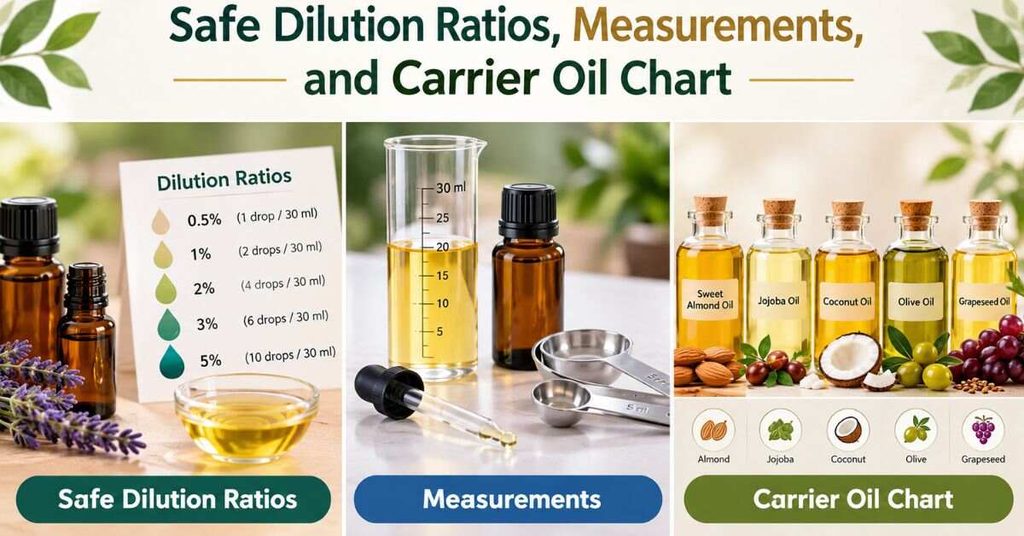
Pure, unadulterated essential oils are highly concentrated botanical extracts that should rarely be applied directly to the skin without proper dilution. Understanding safe dilution ratios remains critical when creating custom body oils, facial serums, or massage mixtures to prevent dermal irritation, sensitization, or unexpected reactions. Furthermore, consulting a detailed essential oil blending chart provides clear percentage guidelines tailored to different application areas and skin sensitivity levels. Consequently, keeping facial treatments at lower concentration thresholds shields delicate dermal barriers from redness or inflammation.
In addition, applying proper dilution rates ensures that potent active compounds deliver therapeutic benefits without overloading sensitive tissue. On the other hand, failing to calculate exact drop proportions often triggers contact discomfort or allergic reactions over time. Therefore, relying on precise formulas from an essential oil blending chart maintains complete safety across all topical formulations. Ultimately, mastering accurate dermal dilution standards allows formulators to craft high-quality, trustworthy body care products with total confidence.
Essential Oil Dilution Chart for Topical Applications
Dilution ensures that potent aromatic molecules disperse safely across the lipid barrier of the skin. A nourishing lipid base like jojoba, sweet almond, or fractionated coconut oil serves as a safe vehicle for delivering concentrated plant drops into dermal tissue safely. Furthermore, referencing a detailed essential oil blending chart helps formulators determine appropriate base-to-active ratios for different skin types. Consequently, diluting potent aromatic extracts in rich plant lipids cushions epidermal layers against sudden redness or stinging. In addition, lipid-rich carrier bases enhance absorption while locking in crucial skin moisture. On the other hand, applying undiluted aromatic drops directly onto dermal barriers often leads to swift sensitization or contact discomfort. Therefore, following precise dilution guidelines on an essential oil blending chart ensures optimal cutaneous tolerance and therapeutic efficacy. Ultimately, selecting high-quality plant-based lipid bases elevates every custom formulation into a safe, deeply restorative body treatment.
- 1% Dilution (Sensitive Skin, Children, Elderly, Facial Care): 1 drop of essential oil per 1 teaspoon (5 mL) of carrier oil, or 6 drops per 1 oz (30 mL). Ideal for delicate facial applications or daily body moisturizing.
- 2% Dilution (Standard Adult Daily Use): 12 drops of total essential oil per 1 ounce (30 mL) of carrier oil, or roughly 2 drops per 1 teaspoon (5 mL). Perfect for general body massage and routine wellness blends.
- 3% to 5% Dilution (Short-Term Targeted Relief): 18 to 30 drops of essential oil per 1 ounce (30 mL) of carrier oil. Best reserved for targeted muscle rubs, joint support, or acute physical discomfort for a limited duration.
Master Essential Oil Dilution Reference Matrix
| Application Purpose | Target Dilution Rate | Drops per 5 mL (1 tsp) | Drops per 10 mL (0.33 oz) | Drops per 30 mL (1 oz) | Primary Safety Focus |
| Facial Serums & Sensitive Skin | 0.5% – 1% | 0.5 – 1 Drop | 1 – 2 Drops | 3 – 6 Drops | Non-comedogenic & gentle formulas |
| Daily Body Massage & Body Oils | 2% | 2 Drops | 4 Drops | 12 Drops | Balanced daily transdermal delivery |
| Targeted Muscle & Joint Rubs | 3% – 4% | 3 – 4 Drops | 6 – 8 Drops | 18 – 24 Drops | Short-term local tissue application |
| Temporary Chest Rubs / Congestion | 5% | 5 Drops | 10 Drops | 30 Drops | Maximum 5-day consecutive use |
Liquid Measurement Conversions: Converting Drops to mL and Percentage Equivalents
Scaling up small custom recipes into 1 oz (30 mL) or 2 oz (60 mL) dropper bottles requires precise mathematical calculations to maintain proper concentration ratios. Furthermore, referencing an essential oil blending chart simplifies multiplying single-use diffuser drops into larger volume batches accurately. Consequently, calculating exact drop ratios prevents costly errors while preserving the original fragrance balance. In addition, using calibrated glass pipettes ensures uniform drop sizes across every liquid measurement.
On the other hand, estimating volume proportions without structured guidance often leads to sensory overload or wasted ingredients. Therefore, relying on standardized conversions from an essential oil blending chart protects product consistency and overall batch quality. Ultimately, mastering accurate scaling techniques allows formulators to prepare long-lasting, professional-grade topical and aromatic stock mixtures with complete confidence.
- Standard Dropper Equivalents: Generally, 1 milliliter (mL) of pure essential oil equals approximately 20 drops (though liquid viscosity varies slightly by botanical type).
- Volume Equivalents: 1 fluid ounce equals roughly 30 mL, which translates to about 600 total drops of pure liquid base.
- Calculating Percentage Math: To achieve a 2% dilution rate in a 30 mL container: 30mL20drops/mL=600drops; then 600drops0.02=12drops of pure essential oil.
Selecting the Right Carrier Oil for Your Skin Type and Aroma Profile
Selecting an appropriate lipid base directly shapes both the skin-nourishing qualities and overall fragrance profile of custom topical formulations. Furthermore, referencing a reliable essential oil blending chart assists formulators in matching specific base oils with complementary aromatic extracts. Consequently, lightweight bases like jojoba or rosehip preserve delicate top notes while providing essential fatty acids to dermal tissue. In addition, richer bases like avocado or unrefined hemp seed introduce subtle nutty undertones that anchor base notes effectively.
On the other hand, using heavily scented or unrefined lipid bases without prior planning can mask subtle floral or citrus elements completely. Therefore, consulting an essential oil blending chart ensures ideal balance between lipid absorption characteristics and intended aromatic longevity. Ultimately, mastering lipid base selection empowers creators to craft deeply hydrating, professional-standard body oils with absolute precision.
- Jojoba Oil (Simmondsia chinensis): Technically a liquid wax ester that closely mimics human sebum. It is ideal for oily, combination, or acne-prone skin, has a neutral scent, and boasts an indefinite shelf-life.
- Sweet Almond Oil (Prunus amygdalus dulcis): Rich in Vitamin E and essential oleic acid. It offers a lightweight texture, making it deeply nourishing for dry or mature body skin.
- Fractionated Coconut Oil (Cocos nucifera): Completely liquid at room temperature, highly stable, odorless, and non-greasy. It absorbs rapidly without clogging pores.
- Argan Oil (Argania spinosa): Packed with protective antioxidants and essential fatty acids. It is the premier choice for facial rejuvenation serums, hair cuticle repair, and mature skin support.
Crucial Safety Guidelines: Patch Testing and Sensitisation Avoidance
Even pure plant extracts can trigger immune contact responses or localized skin irritation when applied improperly. Furthermore, consulting a detailed essential oil blending chart provides reliable dilution guidance to prevent adverse dermal reactions. Consequently, conducting a standard 24-hour patch test on the inner forearm helps identify individual sensitivities before full application.
In addition, mixing concentrated drops into protective carrier bases like jojoba or sweet almond lowers sensitization risks significantly. On the other hand, applying raw aromatic compounds directly to compromised skin barriers often leads to immediate redness or stinging. Therefore, strictly adhering to safety ratios from an essential oil blending chart safeguards delicate skin health. Ultimately, practicing mindful topical application ensures effective, harm-free botanical wellness routines.
- The 24-Hour Patch Test Protocol: Mix 1 drop of your essential oil in 1 teaspoon of carrier oil. Apply a dime-sized amount to your inner forearm crease, cover with a bandage, and observe for 24 hours. Discontinue immediately if redness, itching, or inflammation occurs.
- Phototoxicity Caution: Cold-pressed citrus oils including Bergamot (Citrus bergamia), Cold-Pressed Lemon, Cold-Pressed Lime, and Bitter Orange contain natural furanocoumarins. Avoid direct sunlight, UV rays, or tanning beds for at least 12 to 18 hours after skin application.
- Strict Ingestion Warning: Never swallow pure essential oils. Highly concentrated plant constituents can cause severe chemical mucosal burns to the mouth, oesophagus, and gastrointestinal tract without clinical supervision.
Special Safety Considerations for Children, Pets, and Sensitive Skin
- Infants and Young Children (Under 2 Years): Avoid applying essential oils topically or diffusing near infants. Gentle botanicals like Roman Chamomile or Lavender should only be used at a maximum 0.25% dilution under qualified advice.
- Pet Safety Dynamics (Dogs & Cats): Domestic pets have heightened olfactory senses, and feline systems lack hepatic enzymes to process aromatic phenols. Diffusing potent volatile extracts like tea tree, peppermint, eucalyptus, or citrus requires strict caution around household animals. Furthermore, checking a reliable essential oil blending chart helps identify concentrated compounds that may pose respiratory or hepatic risks to sensitive pets.
- Consequently, dispersing strong airborne vapors in closed, unventilated spaces can quickly trigger distress or toxicity in cats and dogs. In addition, providing an open door ensures animals can freely escape rooms whenever scents become overwhelming. On the other hand, trapping pets in confined spaces forces prolonged exposure to intense aromatic molecules. Therefore, reviewing safety guidelines on an essential oil blending chart protects domestic companions from accidental harm. Ultimately, prioritizing proper ventilation maintains a safe, pet-friendly home environment.
- Pregnancy & Health Conditions: Uterine-stimulating or hormone-modulating oils like Clary Sage, Rosemary, and Cinnamon Bark should be strictly avoided during pregnancy, especially in the first trimester.
Step-by-Step Guide: How to Create Your Own Custom Blends
Translating theoretical ratios into a signature aroma is a rewarding process. By using your essential oil blending chart as a guide, you can formulate custom mixtures tailored to specific emotional and physical needs.
Step 1: Setting Your Aromatherapy Goal (Relaxation, Focus, Energy, Skin)
Before opening a single glass container, defining the primary objective of your custom formulation ensures targeted, effective results. Furthermore, checking a reliable essential oil blending chart helps align specific plant extracts with distinct therapeutic needs like relaxation, focus, or skin nourishment. Consequently, understanding each oil’s unique active constituents narrows down the selection process and prevents wasteful experimentation. In addition, clarifying your precise goal allows you to balance aromatic performance with dermal safety standards. On the other hand, mixing volatile compounds without a clear intention can lead to mismatched scent profiles or ineffective mixtures. Therefore, utilizing structured guidance from an essential oil blending chart establishes a solid foundation before measuring any drops. Ultimately, setting clear formulation goals guarantees high-quality, purposeful recipes tailored to your exact wellness needs.
- Deep Relaxation & Sleep: Target oils rich in linalool and esters, such as Lavender, Roman Chamomile, and Sweet Marjoram.
- Mental Focus & Productivity: Select clarifying, oxide-rich oils like Rosemary, Peppermint, Spearmint, and Lemon.
- Energy & Mood Elevation: Choose bright citrus options like Pink Grapefruit, Bergamot, and Mandarin.
- Skin Renewal & Soothing: Opt for skin-friendly extracts such as Frankincense, Geranium, Tea Tree, and Rosehip seed carrier oil.
Step 2: Selecting Your Base, Middle, and Top Essential Oils
Once your objective is set, choose one to two oils from each note category on your essential oil blending chart to build a balanced scent profile:
- Select Your Base Note (The Anchor): Choose a grounding oil like Cedarwood, Frankincense, or Patchouli to bind the fragrance.
- Select Your Middle Note (The Core Body): Pick a harmonizing floral, herbal, or warm spice note like Lavender, Geranium, or Rosemary to create the body.
- Select Your Top Note (The First Impression): Pick a lively citrus or minty oil like Bergamot, Lemon, or Peppermint to provide an energetic initial lift.
Step 3: Applying Ratios and Calculating Drop Counts
Now apply the standard 30-50-20 rule to determine your exact drop counts. For a standard 10-drop diffuser formula or starter sample:
- Top Notes (30%): 3 drops of Lemon or Bergamot
- Middle Notes (50%): 5 drops of French Lavender
- Base Notes (20%): 2 drops of Cedarwood or Frankincense
Expanding a custom formula into a 1 oz (30 mL) bottle diluted at 2% concentration requires scaling up proportions accurately to reach exactly 12 total drops. Furthermore, referencing a detailed essential oil blending chart simplifies converting small test samples into full-sized dermal preparations. Consequently, measuring 30 mL of jojoba oil creates a nourishing liquid base that carries volatile aromatic molecules safely into skin layers. In addition, distributing those 12 concentrated drops across top, middle, and base notes maintains ideal scent equilibrium. On the other hand, exceeding this total drop count increases the risk of dermal irritation or sensitization. Therefore, relying on precise calculations from an essential oil blending chart protects sensitive skin barriers while delivering consistent therapeutic benefits. Ultimately, following exact percentage scaling methods ensures professional, high-quality results for every batch.
- 4 drops Top Note (Citrus)
- 6 drops Middle Note (Floral/Herbal)
- 2 drops Base Note (Woody/Earthy)
The Water-to-Oil Ratio Rule for Diffusers vs. Topical Application
The way you use your blend determines how concentrated it should be:
Ultrasonic Diffuser Application
- Standard 100 mL Water Tank: Use 3 to 5 drops of pure essential oil blend total.
- Large 300 mL to 500 mL Water Tank: Use 8 to 12 drops total.
- Note: Never add carrier oils to an ultrasonic water diffuser, as vegetable fats will clog and damage the internal ultrasonic disc.
Topical Body & Facial Application
- Always Dilute: Pure essential oils must always be blended into a lipid carrier oil (such as jojoba, squalane, or argan oil) prior to skin contact.
- Follow Dilution Benchmarks: Stick strictly to 1% for delicate facial skin and 2% for standard daily body application.
Practical DIY Exercise: Hands-On Step-by-Step Blending Practice
Following a structured practical workflow guarantees smooth execution and precise measurement when preparing your initial custom formulation. Furthermore, checking a reliable essential oil blending chart simplifies choosing appropriate drop ratios and complementary scent profiles. Consequently, beginning with sanitized glass containers protects pure plant extracts from accidental contamination. In addition, carefully measuring liquid carrier bases like jojoba or sweet almond establishes a safe foundation for topical use. On the other hand, adding concentrated aromatic drops without a clear reference guide can ruin batch proportions. Therefore, following sequential instructions from an essential oil blending chart ensures predictable, high-quality results. Ultimately, maintaining methodical step-by-step habits empowers beginners to craft balanced, professional-grade recipes confidently.
- Gather Your Supplies: Amber glass dropper bottle, glass pipettes, cotton scent strips, carrier oil, and chosen essential oils.
- Add Oils Base-First: Open your amber bottle and add your base notes first. Follow with your middle notes, and finish with your high-volatility top notes.
- Swirl Gently: Cap the bottle and swirl gently in a circular motion for 10 seconds. Do not shake vigorously, as this introduces excessive oxygen into the liquid.
- Smell and Evaluate: Place a single drop onto a paper scent strip and waft it gently under your nose.
Testing Your Blend: Evaluating Scent Evolution Over 24 Hours
A balanced blend changes as its volatile components evaporate at different speeds. To evaluate your creation properly:
- Initial Sniff (0 to 15 Minutes): The top notes will dominate, delivering a bright, crisp scent impression.
- Mid-Point Sniff (1 to 3 Hours): The heart notes emerge as the top notes soften, revealing the true character of your mix.
- Final Base Sniff (6 to 24 Hours): The base notes linger, leaving a subtle, warm, and grounding scent trail.
If a liquid custom recipe feels unfinished at any stage, consulting a comprehensive essential oil blending chart provides immediate clarity for adjusting scent proportions. Furthermore, checking this reference guide helps formulators rebalance top, middle, or base notes without wasting precious plant extracts. Consequently, adding a single drop of bright citrus can instantly lift flat aromas, while adding grounding resins deepens lighter notes. In addition, allowing custom formulations to rest for twenty-four hours gives volatile aromatic molecules sufficient time to fuse together completely. On the other hand, making hasty adjustments without measuring drop counts can ruin an otherwise promising scent profile. Therefore, making controlled, incremental tweaks based on an essential oil blending chart ensures predictable, high-quality results. Ultimately, patient fine-tuning turns imperfect formulations into well-balanced, professional-grade recipes.
Tested Master Blend Recipes Using Your Essential Oil Blending Chart
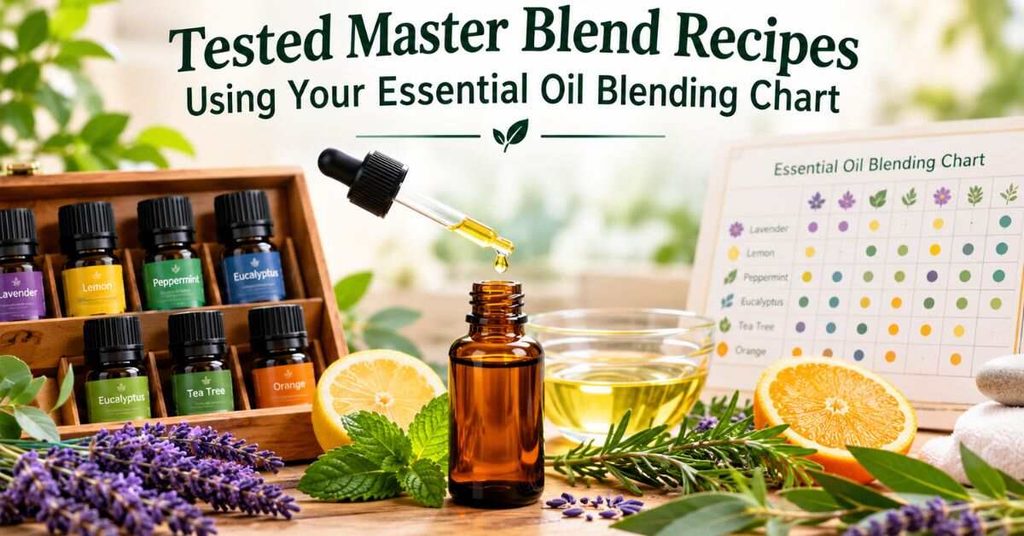
Putting your knowledge into practice is the best way to master aromatherapy formulation. By referencing a professional essential oil blending chart, you can combine complementary plant extracts to create signature room diffusers and body care oils that serve specific therapeutic purposes.
Calming & Sleep Support Essential Oil Blend Recipes
Restful sleep requires soothing plant extracts that quiet an active nervous system, slow down breathing, and ease physical tension before bedtime. Furthermore, checking a reliable essential oil blending chart allows users to mix relaxing compounds like roman chamomile, vetiver, and sweet marjoram accurately. Consequently, pairing delicate floral scents with deep woody notes fosters deep relaxation and prepares the body for slumber. In addition, diffusing these calming liquid mixtures throughout the bedroom creates an inviting night time atmosphere. On the other hand, using improperly balanced drop ratios can stimulate the senses instead of promoting restfulness. Therefore, relying on precise guidelines from an essential oil blending chart ensures safe, effective evening routines. Ultimately, integrating gentle aromatic practices helps restore healthy sleep patterns naturally.
- Lavender-Cedarwood Dream Drift (Diffuser Recipe): Combine 4 drops of French Lavender (middle note), 2 drops of Cedarwood (base note), and 1 drop of Bergamot (top note) in your ultrasonic diffuser 30 minutes before sleep.
- Deep Slumber Massage Oil (Topical 2% Dilution): Mix 6 drops of Lavender, 4 drops of Roman Chamomile, and 2 drops of Vetiver into 1 oz (30 mL) of sweet almond carrier oil. Massage gently onto your chest and soles of your feet.
- Nighttime Pillow Mist: In a 2 oz glass spray bottle filled with distilled water and a splash of witch hazel, blend 10 drops of Lavender and 5 drops of Clary Sage for a soothing, non-staining fabric spray.
Stress Relief & Mental Clarity Aromatherapy Pairings
When daily pressures mount, grounding and uplifting natural pairings help restore emotional balance and clear mental fatigue effectively. Furthermore, referring to a well-structured essential oil blending chart simplifies choosing compatible scent notes like bergamot, frankincense, and lavender. Consequently, combining bright citrus notes with rich resinous aromas eases internal stress while promoting sharp focus. In addition, diffusing these balanced scents creates a calming home environment that refreshes exhausted minds. On the other hand, mixing intense oils without measuring drop ratios can lead to harsh, overwhelming aromas. Therefore, following precise ratios from an essential oil blending chart guarantees consistent, soothing results every time. Ultimately, integrating simple aromatherapeutic routines offers reliable support for lasting daily wellness.
- Anxiety Release Diffuser Blend: Add 3 drops of Bergamot, 2 drops of Frankincense, and 2 drops of Sweet Orange to your diffuser water tank.
- Midday Reset Personal Inhaler: Combine 5 drops of Sweet Orange, 3 drops of Frankincense, and 2 drops of Geranium on a personal cotton wick inhaler for quick relief during stressful work hours.
- Calming Pulse-Point Rollerball (2% Dilution): In a 10 mL roller bottle filled with fractionated coconut oil, combine 3 drops of Bergamot, 2 drops of Lavender, and 1 kind drop of Patchouli. Swipe onto wrists and neck when feeling overwhelmed.
Focus, Memory & Morning Energy Boost Blend Recipes
Kickstart your morning productivity with sharp, stimulating oils that promote alertness, clarity, and sustained mental focus.
- Morning Wake-Up Diffuser Formula: Mix 4 drops of Peppermint, 3 drops of Rosemary, and 2 drops of Lemon to instantly invigorate your home office space.
- Study Session Concentration Blend: Combine 3 drops of Eucalyptus, 3 drops of Lemon, and 2 drops of Rosemary in a diffuser to support deep concentration and clear breathing during long tasks.
- Energy Boosting Hair & Scalp Rub (2% Dilution): Blend 4 drops of Rosemary, 3 drops of Peppermint, and 2 drops of Cedarwood into 1 oz of jojoba oil. Massaging customized hair oils into the scalp roughly twenty minutes before washing actively stimulates local microcirculation and nourishes dormant hair follicles. Furthermore, consulting a reliable essential oil blending chart ensures that stimulating plant extracts like peppermint, rosemary, and cedarwood are diluted at safe percentages.
- Consequently, blending concentrated drops into soothing base oils like jojoba or pumpkin seed protects sensitive scalp skin from irritation. In addition, gentle fingertip pressure across the scalp helps distribute nutrients evenly while loosening excess sebum build-up. On the other hand, applying undiluted extracts directly to hair roots can cause severe redness or inflammation. Therefore, following precise dilution guidelines on an essential oil blending chart creates balanced scalp treatments that foster optimal hair health. Ultimately, integrating this simple pre-wash routine elevates weekly hair care with safe, professional results.
Immune Support & Seasonal Wellness Blends
Seasonal transitions often demand purifying and warming plant extracts that promote clear breathing and steady seasonal wellness. Furthermore, utilizing a detailed essential oil blending chart simplifies selecting harmonious herbal ingredients like eucalyptus, thyme, and rosemary. Consequently, combining sharp camphoraceous scents with soothing citrus oils helps clarify indoor air during colder months.
In addition, mixing these comforting extracts into warm carrier bases creates soothing chest rubs for chilly evenings. On the other hand, improper drop proportions can cause harsh nasal irritation or unpleasant scent clashes. Therefore, following precise ratios from an essential oil blending chart ensures safe, balanced formulations that support daily comfort. Ultimately, thoughtful natural preparation empowers individuals to navigate changing weather with confidence.
- Purifying Air Cleanse Diffuser Recipe: Combine 3 drops of Tea Tree, 3 drops of Eucalyptus, and 2 drops of Lemon to neutralize stale indoor air and freshen your living environment.
- Chest Comfort Steam Inhalation: Add 2 drops of Eucalyptus and 1 drop of Tea Tree to a bowl of hot steaming water. Drape a towel over your head and breathe deeply with closed eyes for 5 minutes.
- Warming Foot Rub for Cold Days (3% Dilution): Mix 5 drops of Sweet Orange, 3 drops of Clove Bud, and 2 drops of Cinnamon Bark into 1 oz of fractionated coconut oil. Massage vigorously into feet and put on warm socks.
Organic Skincare & Facial Nurturing Essential Oil Combinations
Nourishing facial serums and body treatments benefit immensely from gentle, skin-repairing botanicals paired with lightweight carrier oils like argan or jojoba.
- Balancing Facial Serum (1% Dilution): In a 1 oz amber dropper bottle of pure jojoba oil, blend 3 drops of Frankincense, 2 drops of Lavender, and 1 drop of Geranium. Apply 2 to 3 drops to clean damp skin nightly.
- Blemish Spot Treatment (2% Dilution): Mix 2 drops of Tea Tree and 1 drop of Lavender into 1 teaspoon of argan oil. Dab directly onto occasional breakouts using a clean cotton swab.
- Radiant Body Glow Massage Oil (2% Dilution): Combine 6 drops of Geranium, 4 drops of Sweet Orange, and 2 drops of Frankincense into 1 oz of sweet almond oil for a luxurious, smoothing post-shower body treatment.
Storing, Labeling, and Preserving Your Custom Essential Oil Blends
Crafting a beautifully balanced formula using your essential oil blending chart is only half the journey. Proper storage, precise labeling, and oxidation prevention are essential to safeguard the therapeutic potency and aroma profile of your custom creations over time.
Best Practices for Bottle Selection, Storage, and Light Protection
Pure essential oils and carrier oils are sensitive to environmental degradation caused by ultraviolet (UV) radiation, heat, and air exposure:
- Always Use Dark Glass Bottles: Store your blends strictly in Amber or Cobalt Blue glass bottles. Dark glass blocks harmful light rays that cause delicate aromatic compounds to break down. Avoid clear glass or soft plastic containers, as pure oils can dissolve certain plastics over time.
- Maintain Temperature Stability: Keep your formulation collection in a cool, dark place with a stable ambient temperature (ideally between 55°F and 68°F / 13°C to 20°C). Avoid storing oils near sunny windows, heat vents, or in humid bathrooms.
- Minimize Headspace in Storage Containers: As you use up a blend, transfer the remaining liquid into smaller glass bottles. Leaving large amounts of empty air space (“headspace”) inside a bottle accelerates oxidation.
How to Label and Update Your Custom Essential Oil Blending Chart Log
A precise labeling system ensures safety and allows you to reproduce your favorite master recipes accurately. Every custom bottle should feature an easy-to-read label with key batch information:
- Blend Name & Purpose: Clear identifier (e.g., “Calming Evening Sleep Serum”).
- Drop Counts & Dilution Rate: Document exact proportions (e.g., 2% Dilution in Jojoba Oil).
- Formulation Date & Batch ID: Essential for tracking freshness and calculating expiration dates.
- Safety Alerts: Clear warnings for phototoxic ingredients (e.g., “Contains Bergamot – Avoid Sun Exposure for 12 Hours”).
Essential Oil Shelf-Life & Stability Reference Chart
| Botanical Oil Category | Estimated Shelf-Life | Primary Degradation Risk | Optimal Preservation Method |
| Citrus Oils (Lemon, Orange, Lime) | 1 to 2 Years | Fast oxidation of monoterpenes | Store in airtight glass inside a refrigerator |
| Herbal & Floral Oils (Lavender, Rosemary) | 2 to 3 Years | Moderate loss of delicate heart notes | Store in cool, dark amber bottles away from heat |
| Woody & Resinous Base Notes (Patchouli, Vetiver) | 4 to 8+ Years | Low risk; aroma deepens with age | Keep tightly sealed at stable room temperature |
| Carrier Oils (Jojoba, Almond, Argan) | 1 to 2 Years | Fatty acid rancidity from oxygen exposure | Add 0.5% Vitamin E Oil (Tocopherol) to extend life |
Printable Custom Blending Log Sheet (Free Template Format)
To organize your formulating workflow, keep a structured logbook in your workspace using this standardized template layout:
| Batch ID | Custom Blend Name | Therapeutic Goal | Top Notes (Drops) | Middle Notes (Drops) | Base Notes (Drops) | Carrier Base & Vol | Date Created | Expiry Date |
| #001 | Focus & Clarity | Work Productivity | Lemon (4) | Rosemary (5) | Frankincense (2) | Jojoba (30 mL) | Oct 2026 | Oct 2027 |
| #002 | Deep Rest | Sleep Support | Sweet Orange (2) | Lavender (6) | Vetiver (2) | Sweet Almond (30 mL) | Oct 2026 | Oct 2027 |
Preventing Oxidation and Extending Scent Shelf-Life
Proper storage plays a crucial role in preserving pure plant extracts and preventing premature oxidation over time. Furthermore, following a comprehensive essential oil blending chart helps formulators calculate precise batch sizes so precious liquids remain fresh. Consequently, storing custom blends in dark amber or cobalt glass bottles shields sensitive aromatic compounds from destructive light degradation. In addition, keeping these containers in cool, temperature-controlled environments minimizes heat-induced chemical breakdown. On the other hand, exposing natural formulations to air leads to rapid evaporation and altered fragrance profiles. Therefore, tightly sealing cap closures immediately after each use maintains full aromatic potency. Ultimately, combining proper glass storage with accurate guidance from an essential oil blending chart guarantees shelf stability and high-quality scent performance for every batch.
- Cap Bottles Immediately: Always screw bottle caps tight right after dropping liquid to reduce evaporation loss and oxygen exposure.
- Avoid Touching Dropper Pipettes: Never touch rubber bulb droppers or glass tips directly against human skin or unsterilized surface areas to prevent bacterial contamination inside the bottle.
- Use Natural Antioxidants for Oil Bases: When formulating lipid topical blends, add 1 to 2 drops of Vitamin E Oil (Tocopherol) to your carrier oil base to extend shelf-life and prevent rancidity.
Conclusion: Elevate Your Aromatherapy Journey with Confidence
Mastering the art and science of aromatherapy becomes effortless when you rely on a structured essential oil blending chart. By understanding fragrance notes, volatility rates, and aromatic families, you eliminate guesswork and ensure every custom creation is balanced, harmonious, and therapeutic.
Whether you craft energizing room sprays, calming pulse-point rollerballs, or nourishing facial serums, success always depends on prioritizing safety protocols. Consequently, consulting a detailed essential oil blending chart provides reliable guidance for calculating accurate dilution percentages across various applications. Furthermore, mastering the classic 30-50-20 rule ensures that top, middle, and base notes harmonize smoothly in every custom mixture.
In addition, mixing concentrated plant extracts into premium carrier bases like jojoba or rosehip oil preserves delicate skin barriers. On the other hand, skipping precise drop ratios can easily lead to dermal sensitivity or unbalanced fragrances. Therefore, careful formulators measure every liquid drop with intention and exact precision. Ultimately, relying on a verified essential oil blending chart empowers creators to craft high-quality, effective recipes with confidence. Proper storage in amber glass bottles will protect your custom blends from oxidation, preserving their natural potency and shelf-life for months to come.
Aromatherapy is both a personal wellness practice and a creative passion. Keep experimenting with small batches, logging your unique drop proportions, and discovering the botanical combinations that best support your mind, skin, and daily lifestyle!
About the Author
Noor Fatima | SEO Expert & Natural Oils Specialist
Credentials:
As an SEO expert and the driving force behind Pure Oils Hub (pureoilshub.com), I combine over 8 years of digital strategy and search optimization with a deep, lifelong passion for organic aromatherapy and plant-based living.
First-Hand Experience:
“Navigating the digital landscape for more than 8 years while researching pure botanical and carrier oils has shown me that creating a truly helpful website takes more than just technical SEO. It requires a genuine commitment to cutting through the noise of commercial, synthetic products to deliver honest, thoroughly researched, and practical guides. My goal is to make natural wellness accessible to everyone, helping you discover the simple, powerful ways pure oils can transform your daily self-care routine.”
FAQs
What is the 30-50-20 rule in an essential oil blending chart?
The 30-50-20 rule is a foundational aromatherapy ratio used by professional formulators to build balanced scent profiles. It distributes your total drop count into three distinct structural notes based on volatility:
- 30% Top Notes: High-volatility oils (like Lemon or Bergamot) that provide the bright, energetic first impression.
- 50% Heart / Middle Notes: Medium-volatility oils (like Lavender or Geranium) that form the main therapeutic body of the blend.
- 20% Base Notes: Low-volatility, heavy oils (like Cedarwood or Frankincense) that anchor volatile notes so the aroma lasts for hours.
Which essential oils pair best together for anxiety and sleep?
For deep relaxation and sleep support, oils rich in natural soothing compounds like linalool and linalyl acetate pair exceptionally well:
- Lavender + Cedarwood: Combines relaxing floral middle notes with a warm, grounding woody base.
- Bergamot + Frankincense: Balances bright, stress-relieving citrus top notes with a deep, meditative resinous anchor.
- Roman Chamomile + Sweet Marjoram: A gentle, deeply comforting herbal-floral blend ideal for nighttime pulse-point application.
How do I convert essential oil drops into mL in a dilution chart?
As a standard conversion benchmark in aromatherapy liquid measurement, 20 drops of pure essential oil equals approximately 1 milliliter (1 mL).
To convert drops to mL across standard container sizes:
- 5 mL Dropper Bottle: Approximately 100 drops total.
- 10 mL Roller Bottle: Approximately 200 drops total.
- 30 mL (1 oz) Dropper Bottle: Approximately 600 drops total.
To calculate a 2% topical dilution in a 30 mL (1 oz) bottle, multiply 600 total drops by 0.02, which equals 12 drops of essential oil diluted into 30 mL of carrier oil.
What essential oils should never be mixed together?
While most plant extracts mix safely, certain combinations clash aromatically or cause sensory overload when users mix contrasting olfactory notes improperly. Fortunately, utilizing a structured essential oil blending chart helps formulators identify conflicting fragrance families before combining valuable liquids. For example, strong medicinal aromas like eucalyptus or tea tree frequently overwhelm delicate floral scents such as jasmine or chamomile. Furthermore, mixing heavy spicy oils like clove with subtle citrus compounds often creates harsh, competing fragrances rather than a unified profile.
Consequently, balance requires selecting complimentary ingredients that support each other without clashing. Additionally, high concentrations of intense wood or herb extracts can trigger sensory fatigue and mild headache sensations during inhalation. Therefore, smart formulation relies on maintaining proper ratio balances between top, middle, and base notes. In addition, verifying notes on an essential oil blending chart protects your custom recipes from unpleasant, muddy aromas. Ultimately, careful planning produces harmonious, therapeutic aromas for every home diffuser or topical recipe.
- Heavy Spice + Soft Florals (e.g., Clove Bud + Jasmine): Pungent spice notes easily overpower soft floral fragrances, ruining their delicate profile.
- Sharp Mint + Deep Damp Earthy Notes (e.g., Peppermint + Patchouli): The intense cooling sharpness of mint conflicts aggressively with the heavy, damp soil notes of Patchouli.
- Medicinal Camphor + Sweet Citrus (e.g., High-Dose Tea Tree + Sweet Orange): Pungent medicinal herbs can make sweet citrus smell sour or off-putting if the drop ratio is imbalanced.
How do I adjust blending ratios when using strong base notes like Vetiver or Patchouli?
Heavy base notes like Vetiver, Patchouli, Oakmoss, and Jasmine have a Blending Factor (BF) of 1 or 2, meaning their scent strength is exceptionally potent.
To prevent them from masking your top and middle notes:
- Reduce Base Note Percentage: Lower the base note ratio from 20% down to 5% or 10% of your total drop count.
- Use the Toothpick Technique: Instead of adding a full drop, dip a clean wooden toothpick into the bottle of Vetiver or Patchouli and swirl it into your blend.
- Balance with Citrus: Add 1 to 2 extra drops of a high-volatility citrus top note like Lemon or Pink Grapefruit to lift heavy base notes.
Can I use an essential oil blending chart for diffuser recipes and topical oils alike?
Yes! An essential oil blending chart acts as a universal reference for aromatic diffusion and topical formulations, offering structured mixing guidance. Furthermore, these guides organize scents into distinct notes so creators achieve balanced profiles. Transitioning to diffusion, this method releases volatile compounds into the air to enhance moods. Consequently, vapor mixtures require careful drop ratios for even note dispersion. Meanwhile, topical application demands strict measurement because extracts interact directly with skin.
Therefore, safety protocols require diluting concentrated botanical oils into liquid carrier bases like jojoba or sweet almond. In addition, safe dermal preparation relies on precise percentage dilutions to protect skin barriers. While diffusion relies on evaporation dynamics, skin application depends on absorption rates and lipid compatibility. Additionally, topical blends account for phototoxicity and dermal limits. Ultimately, utilizing an essential oil blending chart bridges safety standards and creative scent design. By distinguishing inhalation ratios from dermal formulas, enthusiasts safely maximize therapeutic benefits.
- For Diffusers: Follow the 30-50-20 note ratio using pure essential oils added directly into the water tank (e.g., 3 to 5 drops total per 100 mL of water). Never add carrier oils to diffusers.
- For Topical Oils: Use the exact same 30-50-20 note ratio to build your scent concentrate, but always dilute the drop count into a lipid carrier oil (such as jojoba or sweet almond oil) at safe rates (1% for face, 2% for body).